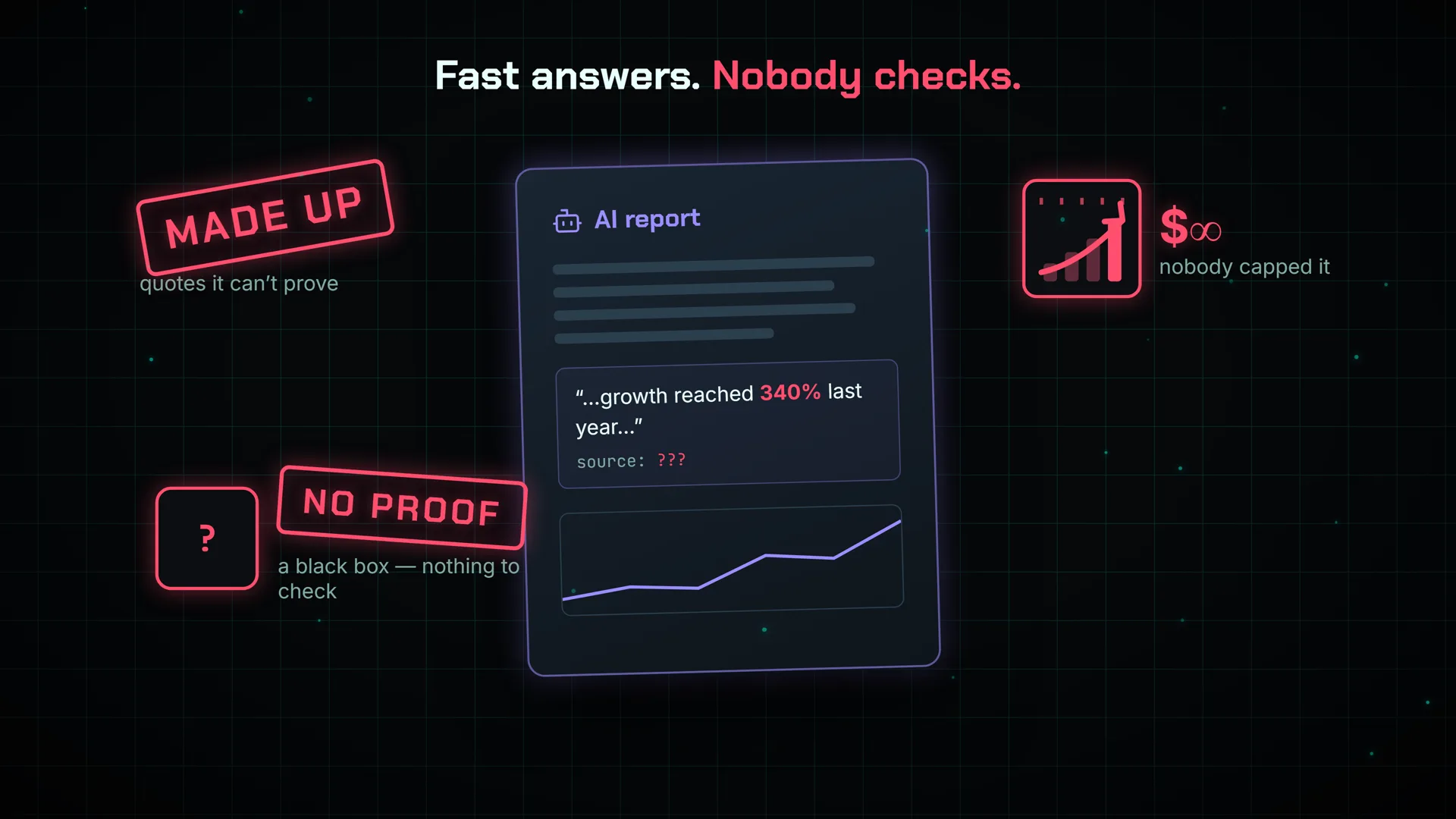
Fast answers. Nobody checks.
LangGraph Multi-Agent Orchestrator
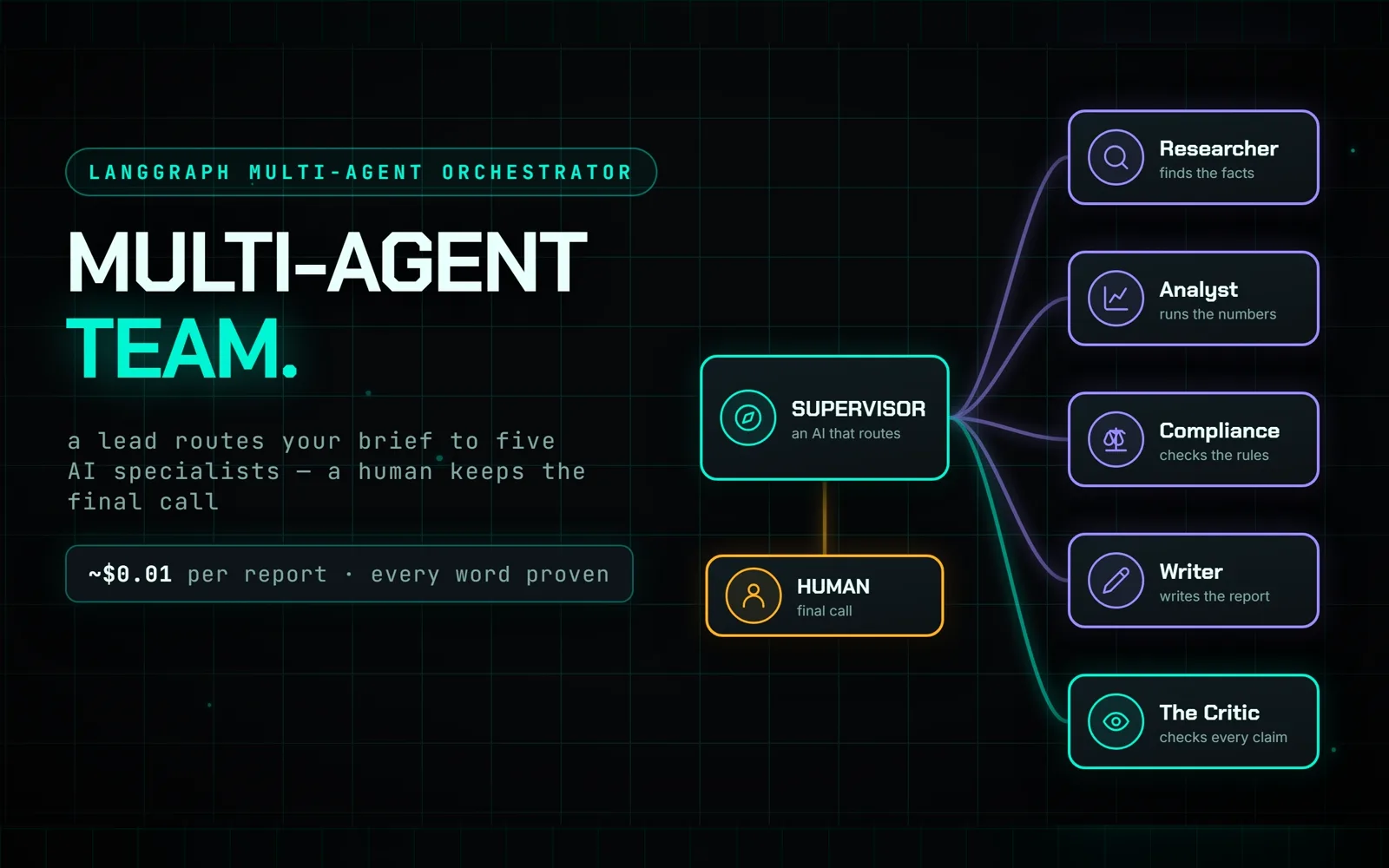
A team of AI specialists that writes your reports and proves every word: dynamic routing, a hard budget and a sealed audit trail.
You could ask an AI for the report. But it makes things up, runs up the bill and can't show its work, and most agent demos hard-wire one pipeline for every kind of report.
Nobody checksA supervisor assembles the team that fits each brief and routes work dynamically; every quote is checked against its source; a dollar budget is enforced before every model call; humans make the final call; and every report is sealed in a hash-chained audit trail.
How it works
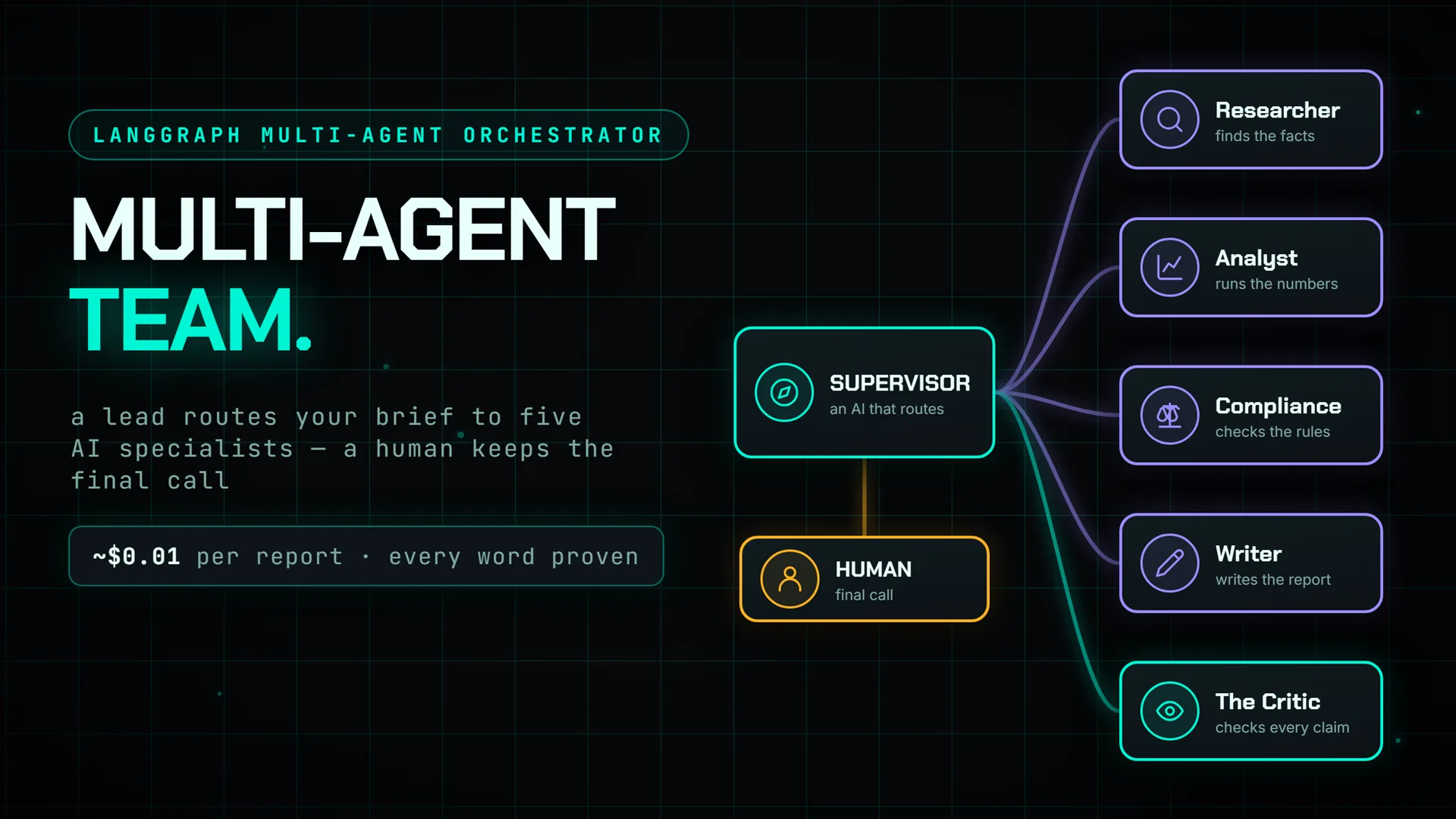
English subtitles burned in · Spanish CC on YouTube
A team lead decides who works.
No fixed edges: a supervisor picks the next specialist at runtime and splits the work in parallel when the brief calls for it. Each report type gets the team it needs.
Promise one: nothing made up.
Every quote in the draft is checked against the source text it cites. A changed figure is caught and sent back for revision before the report ships.
Promise two: no runaway bills.
Every job carries a dollar budget that is checked before each model call. Over budget, it stops and asks a human to fund, approve or reject.
Promise three: proof for every word.
Every finished report is sealed in a SHA-256 hash chain, and its footnotes carry the hash of their evidence. Change one line and verification fails.
The code enforces. You decide.
Exhausted debates escalate through a real LangGraph interrupt on a SQLite checkpointer. A paused job survives a restart and waits for your call.
Nothing ships unless it wins.
Prompts are versioned and A/B tested on the same dataset; a candidate goes live only if it beats the current version. When writer v2 scored lower, v1 stayed live.
Architecture
Runtime flow
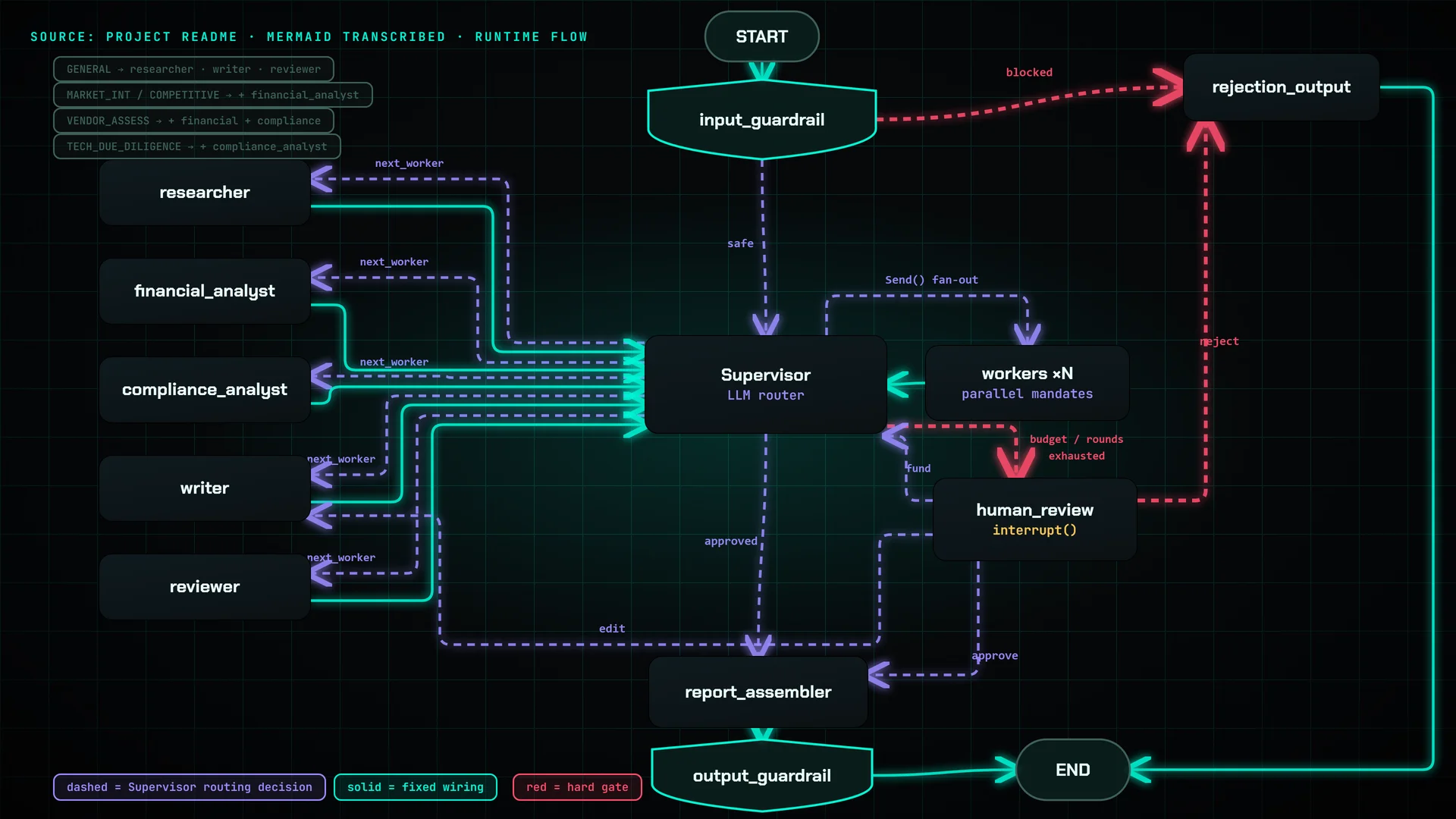
Text description of the diagram
START enters input_guardrail. Blocked input goes to rejection_output and END; safe input reaches the Supervisor, an LLM router. Dashed edges are routing decisions, solid edges are fixed wiring. The Supervisor dispatches each specialist — researcher, financial_analyst, compliance_analyst, writer, reviewer — through next_worker, or fans out parallel mandates via Send(); every worker returns to the Supervisor, which decides whether the reviewer's verdict needs another revision round. When budget or rounds are exhausted, control passes to human_review (interrupt()): fund returns to the Supervisor with a topped-up budget, edit sends the reviewer's feedback plus the human's note straight to the writer, approve goes to report_assembler and reject to rejection_output. Once approved, report_assembler re-verifies every citation and seals the transcript, and output_guardrail screens the finished report for prompt leakage before END.
System view
Text description of the diagram
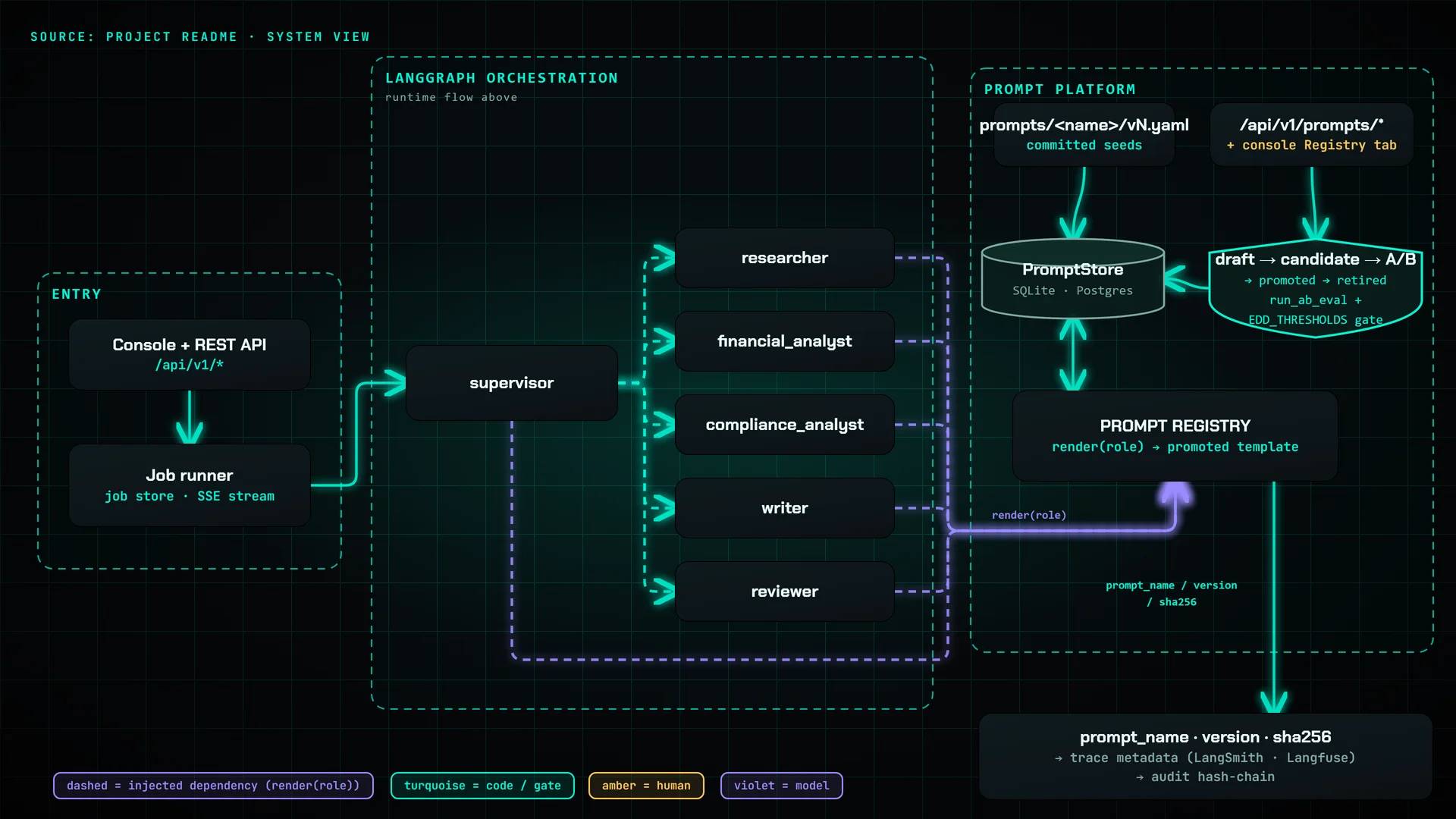
Prompts are injected, not routed: the Prompt Registry is a dependency of every agent, not a graph node, which is why the runtime flow shows no edges to it. The console and REST API submit jobs to the job runner, which drives the LangGraph orchestration. The supervisor, researcher, financial_analyst, compliance_analyst, writer and reviewer each call render(role) on the registry to get their promoted template. The registry reads and writes a PromptStore (SQLite or Postgres) seeded from committed YAML files. New versions come in through the prompts API and the console Registry tab and move through draft → candidate → A/B → promoted → retired, gated by run_ab_eval against the EDD thresholds. Every generation carries the prompt name, version and SHA-256 into trace metadata (LangSmith or Langfuse) and the audit hash-chain.
Measured. Not claimed.
- The held-out proof is 2 complete passing runs plus 2 runs truncated by the spend cap; 22 briefs is a gate, not a benchmark.
- Held-out numbers were measured on gpt-4o-mini: a lower bound, not a guarantee for other models.
- The audit chain is tamper-evident, not tamper-proof.
A real product. Not a slide.
Stack

Need agents you can trust with real work?
Let's build yours: a team of specialists for your reports, under budget and audited.